
Randolph Projected vs Actual Release
A projected release date is a working calculation. It can be based on sentence length, jail credit, correctional incentive time, parole action, mandatory supervision, court orders, holds, and discipline. An actual release date is the date custody ended for that agency. In Randolph County, those two dates may live in different records. The jail record confirms a local jail release. ADOC calculates state prison custody. ABPP records explain parole or mandatory supervision. Court records explain bond, sentence, revocation, or dismissal.
The safest reading starts with custody status. A person on the Randolph County Sheriff's Office inmate roster is in current local custody. A person transferred to ADOC may no longer be a county jail inmate but may still be incarcerated. A person released to supervision may have left prison or jail but still have ABPP reporting duties. The date question changes with each status.
Randolph Release Date Sources
One common error is treating every release date as an ADOC date. Randolph County has county jail releases, state prison releases, court-controlled bond releases, and supervision dates. The Randolph County Detention Center release record is the source for a local booking that ended by bond, court order, time served, transfer, or sentence completion. ADOC and ABPP sources become central after a person is sentenced to state prison or released to state supervision.
| Situation | Date to look for | Primary source |
|---|---|---|
| Pending Randolph County case | No fixed release date unless bond or court action creates one. | Sheriff roster, detention center, Randolph County court record. |
| County jail sentence | Local jail release or discharge date. | Randolph County Detention Center and sentencing court. |
| ADOC sentence | Minimum, projected, mandatory supervision, or actual prison release date. | ADOC, VNS, ABPP, court record. |
| Parole review | Parole consideration or hearing result, not guaranteed release. | ABPP hearing schedule and results. |
Find Randolph County Release Dates
A release-date search should move from the most local source to the statewide source only when the facts call for it. A current county jail booking is not calculated by the public ADOC search. A historical ADOC release may not remain visible in the public ADOC search because Alabama says that database contains only currently incarcerated inmates and that historical data is not available online.
- Check the Randolph County current roster first. If the person appears, read the booking date and charge details as current-custody information, not as a projected release date.
- For a recent local booking that no longer appears, contact the Randolph County Detention Center or request the booking sheet, jail register entry, and release date through the proper custodian.
- Use the Randolph County Circuit Clerk and Alacourt Access for bond orders, sentencing, probation, time-served credit, revocation, and disposition.
- For an ADOC prisoner, search the Alabama Department of Corrections inmate search by AIS number, first name, or last name.
- If a projected or minimum release date is not visible, or the person has left ADOC custody, use ADOC public records, Alabama VNS, ABPP records, and the sentencing court.
- For release alerts, use VINELink inmate check where the person or case is covered by Alabama VNS or VINELink Alabama.
For a named-person search across release records, the broader workflow starts at Randolph County released inmates. That path separates roster status, release records, court records, ADOC records, and supervision records.
ADOC Release Date Limits
Alabama's public ADOC search is useful, but its own limits control how it should be used for Randolph County release dates. The ADOC search page states that the database only contains currently incarcerated inmates and that historical data is not available online. It also says the AIS number is the unique six-digit number assigned to each inmate and takes precedence over name fields. First and last name fields can be used separately or together, but displayed results can be limited.
That means an absent ADOC result does not prove a person was never sentenced to prison or was released on a certain date. It may mean the person is no longer in ADOC custody, is excluded from the public search, has a name variation, or needs an AIS-based records request. ADOC also notes that Youthful Offender Act cases are not included in the public inmate search.
The screenshot below comes from the ADOC inmate search, which is the first public statewide source for a Randolph County person still in state custody.
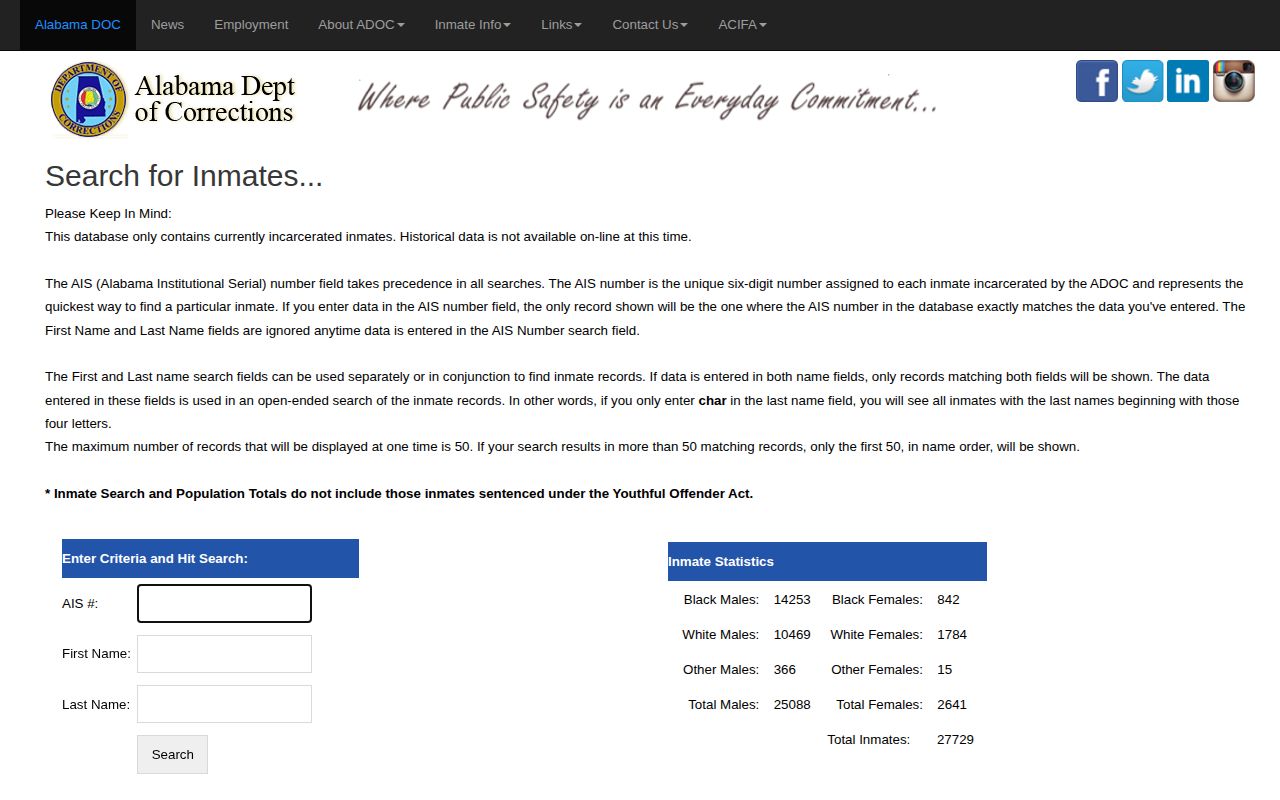
Use that search as a current-custody check, then move to ADOC public records when a historical release or unavailable projected date must be confirmed.
Alabama Good-Time Rules
Alabama's release-date computation has a county jail angle. Alabama Code Section 14-9-41 governs correctional incentive time. It sets earning classes: Class I can earn 30 days for each 30 days served, Class II can earn 15 days for each 30 days served, Class III can earn five days for each 30 days served, and Class IV earns no correctional incentive time. The statute includes exclusions, including Class A felonies, certain deadly-weapon death cases, life or death sentences, sentences over 15 years, and child-involved sex offenses as defined by statute.
The same statute assigns administration by custody type. ADOC administers it for state penal institutions. The sheriff administers it for county jail prisoners where applicable. The chief of police administers it for municipal jail prisoners where applicable. For Randolph County, that means a local jail sentence is not computed by the public ADOC search unless the person is actually in ADOC custody.
County jail good-time questions should be treated as records questions, not math problems solved from the roster. The public Randolph County roster does not display a release-date calculation, sentence-credit balance, discipline history, or hold status. If a person is serving a local sentence, the sentencing order, jail credit, classification, and sheriff-administered records determine how the date is applied. If the person is only awaiting court action, there may be no projected release date at all because bond, court orders, and holds control the next step.
Note: Good-time language should not be treated as a calculator because classification, discipline, sentence type, court orders, holds, and credits can change the result.
Parole and Mandatory Supervision
Parole consideration is not a release date. Alabama Code Section 15-22-28 sets initial parole consideration schedules. For prisoners receiving correctional incentive time, the schedule depends on sentence length and minimum release date. For specified Class A felonies committed on or after March 21, 2001, initial consideration comes after completion of 85 percent of the total sentence or 15 years, whichever is less. For other prisoners, initial consideration generally follows completion of one-third of the sentence or 10 years, whichever is less, subject to the statute.
Mandatory supervision is different. Section 15-22-26.2 requires certain ADOC defendants to be released to ABPP supervision before the release date unless released to probation or parole. The windows are three to five months before release for sentences of five years or less, six to nine months for more than five but less than 10 years, and 10 to 12 months for 10 years or more. The statute excludes child-involved sex offenses as defined by law and requires notice through the victim notification system before release to supervision.
Why Randolph Release Dates Change
Projected dates change because release is not a single static number. A Randolph County jail date can move because a judge modifies bond, enters a sentence, credits time served, issues a hold, or orders transfer. A state prison projected date can move because of incentive time, discipline, sentence recalculation, parole action, mandatory supervision, new charges, or detainers from another agency.
| Change factor | How it affects a projected release date |
|---|---|
| Court order | Bond, sentence, dismissal, revocation, or jail credit can alter the local release path. |
| Correctional incentive time | Earned, forfeited, or restored time can change a calculated county or ADOC date. |
| Detainer or hold | Another agency can prevent community release even when the local custody episode ends. |
| Parole result | A grant, denial, reset, or special condition can affect release timing from ADOC custody. |
| Mandatory supervision | Eligible ADOC sentences may move to ABPP supervision before the final release date. |
| Data correction | Clerical or sentence-calculation corrections can change a displayed or reported date. |
Confirm Randolph Release Dates
Confirmation should come from the office that controls the record. For a Randolph County Detention Center release, use the sheriff or jail records path. For a state prisoner, use ADOC current search while the person is incarcerated and ADOC public records for historical release information. For parole or mandatory supervision, use ABPP hearing results, the Wedowee Field Office, and VNS notifications where the person is covered.
The county court record often explains why a date changed. It can show bond action, sentencing, time-served credit, probation, revocation, warrant recall, dismissal, or transfer language. The Alacourt Access system is the statewide trial-court lookup, and the local Circuit Clerk remains the Randolph County court contact.
Federal release dates do not come from the county jail or ADOC unless a transfer record points to federal custody. Use the BOP locator for federal custody and release status. For immigration detention, use ICE or the proper agency path. Randolph County research did not identify a federal or ICE detention center physically located in the county.
For a written request, name the exact date type being sought. "Projected release date" may mean an ADOC calculation, while "jail release date" means the end of a Randolph County custody episode. "Parole consideration date" means a board-review schedule, and "mandatory supervision date" means a statutory move to ABPP supervision for certain ADOC sentences. Clear wording helps the custodian send the request to the right record set.
Randolph County's posted open-records process also shows why precision matters. The county requires reasonably specific requests for county-held records and may require estimated administrative fees before records are provided or a time-intensive search begins. For sheriff records, start with the sheriff or detention center because they operate the jail. For Commission-held records, follow the county's posted public-records procedure. For ADOC or ABPP records, use those agencies' own forms and contacts rather than the county form. Keep copies of replies because later date changes may need agency context.